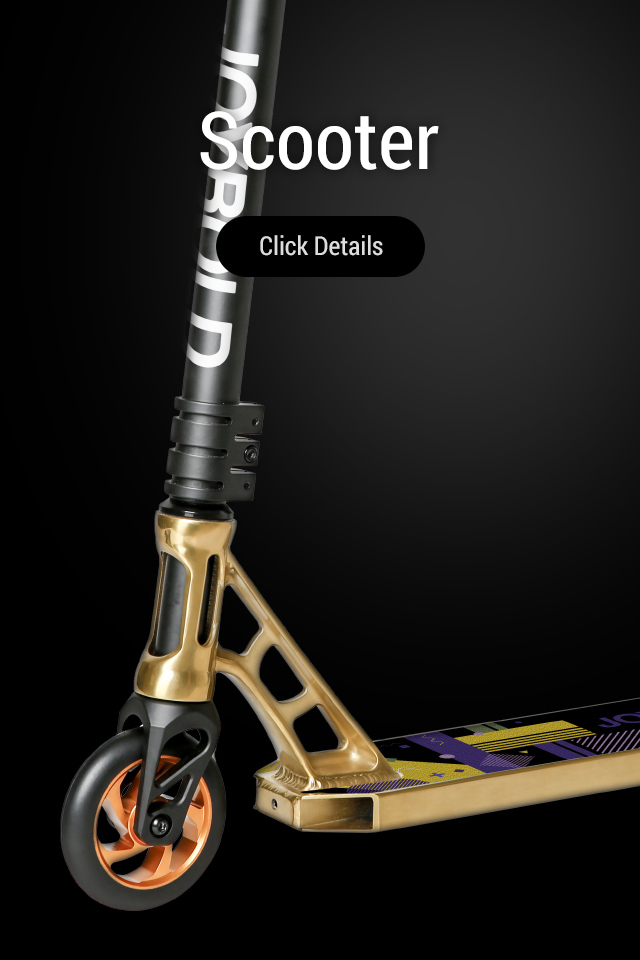
A distributor who ranges freestyle scooters may face a shelf-edge question: a buyer asks for a trick scooter, a supplier quotes a stunt scooter, and someone in the middle wonders whether these are two products or one. This guide does not treat the two names as a product classification: the catalogue records this factory's PRO scooter line, and it does not record an equivalence — or a difference — between the names "trick scooter" and "stunt scooter". The vocabulary still matters, because the name on a listing is part of what a range promises. This guide separates the vocabulary from the engineering, so a retail or distribution team can name products from its own market records and buy them against written specifications.
How this guide records the two names
The two names are recorded in this guide as names to check against your own market, not as a classification this guide assigns; the catalogue does not state whether the two names stand for the same products or for different ones, and this guide does not state where either name originated, or in which market either name is used more. Which term your own market uses is a question to check from your own listings, search records and retail partners, and to record in the programme file. A third term, "freestyle scooter", and the term "pro scooter" — used in this factory's own long-standing PRO scooter line — can be recorded in the same file as alternative names to check against your own market, rather than as names this guide assigns to a market.
Whether any of these names stands for a different mechanism, a different construction or a different certification position for a given model is not recorded in the catalogue; it is a question to settle for that model in writing at quotation, not an answer to read off the name. When two suppliers use different words for a sample under discussion, settle the specification conversation in writing for that sample rather than treating the word itself as a specification.
The differences that actually matter
Whether or not the names separate products in a given quotation, the specifications are what a buying file can record — and in this category the specifications are exactly what a catalogue listing does not state. Whether a given freestyle reference has a folding or a fixed steering column, how its deck is constructed, what its headset and compression arrangement is, and what its handlebar format is are not recorded against any catalogue reference here. The honest buying method is therefore the same for every item on the verification list: put the column format, the deck construction, the headset and compression specification, and the handlebar format your programme requires in the brief, and settle each one in writing and on samples for the exact model, rather than assuming any of them from the category name. The wheels belong on the same list: core construction and diameter are likewise not stated against any catalogue reference, so they take the same brief-and-sample route.
Used that way, the verification list is a tool a buying team can apply to a sample: it records, item by item, what the supplier confirmed in writing for that sample against the brief. A distributor's buying team can apply it to any sample, whatever the supplier calls the product — the answers come from the written confirmation and the sample, not from the name.
Why the vocabulary still matters commercially
If the specification conversation is the same either way, why care about the name? Because the name on the listing is part of the specification decision for your own range. Which vocabulary your own customers and retail partners use is a question to check from your own market records — your own search data, enquiries and staff feedback — and to record in the programme file, rather than a pattern this guide states for any market. The practical step for a distributor is to carry, in the product name and descriptions, the terms you have recorded for your own market, and to include any synonym you have recorded in staff training notes and search metadata, so your own range naming is consistent across your own listings.
There is also a naming question to handle in the brief. State, in the brief, the use the model is being bought for, and check the name you plan to sell it under against the specification confirmed in writing for that exact model. Selling a model under a name when its confirmed specification does not record the use stated in your brief is a mismatch to resolve before the listing is written, not after. The terminology guide rule is simple: the name recorded for your own market may be the one you use, but the specification in the buying file is what that name must match, model by model.
How a range plan can structure the category
A retail range plan can be written in three tiers. An entry tier for younger, lighter riders moving up from a standard kick scooter, where the brief states the weight and strength expectations for that position. A core tier for committed park riders, with the specification the programme can document for that position. And a premium or complete-custom tier where components, finishes and graphics are specified for the price position. The names on the boxes can follow local vocabulary across all three tiers; the specification for each tier should be recorded separately in the buying file, tier by tier.
When you brief a stunt scooter programme, brief the tiers, not just the models: for each tier, record the construction and specification items the supplier confirms in writing and the points the sample must settle, so the ladder rests on documents rather than on tier names.
The bottom line for distributors
Buy against a written specification, name the product from the vocabulary you have recorded for your own market, and do not let either word appear on a model whose confirmed specification does not support the use stated in your brief. The question to keep in the buying file is whether the specification recorded for the model matches the product in the box. For the trade programme behind this terminology, see the stunt scooter page, or start from the wider kick scooter range.
Recording the names your own market uses
What riders call the product in a given place is a question to check from your own market records, not a pattern this guide states. For a distributor, the practical conclusion is to write listings using the vocabulary you have recorded for your own market, train staff to translate freely between the terms you have recorded, and spend the energy saved on vocabulary on the specification questions that actually protect the customer: the column format, deck construction, steering assembly, wheel core and diameter, and bar height — each one to be confirmed in writing and settled on samples for the exact model.
One final naming point is worth flagging. A name on a quotation is not a construction record: whatever name a quotation uses, record against it the construction the supplier confirms in writing for that exact model. A buying team can apply the verification list in this guide — written confirmations first, samples second — to record which products match its brief and which do not, whatever language the quotation is written in.
Distributors sometimes ask whether the terminology affects safety expectations. Indirectly, yes: a product named for stunts invites stunt use, and the demands of that intended use belong in the specification brief for the model. That is one more reason the naming decision belongs with the specification decision. If the range plan calls a model a stunt or trick scooter, the buying file for that model should record, item by item, what the supplier confirmed in writing for that model — column format, deck construction, headset and wheel specification among them — so that the claim on the box can be traced to the documented specification, season after season, even as staff change.
Send model references, your target market and branding requirements — MOQ and lead time are confirmed per quotation in writing.
Request a Quotation