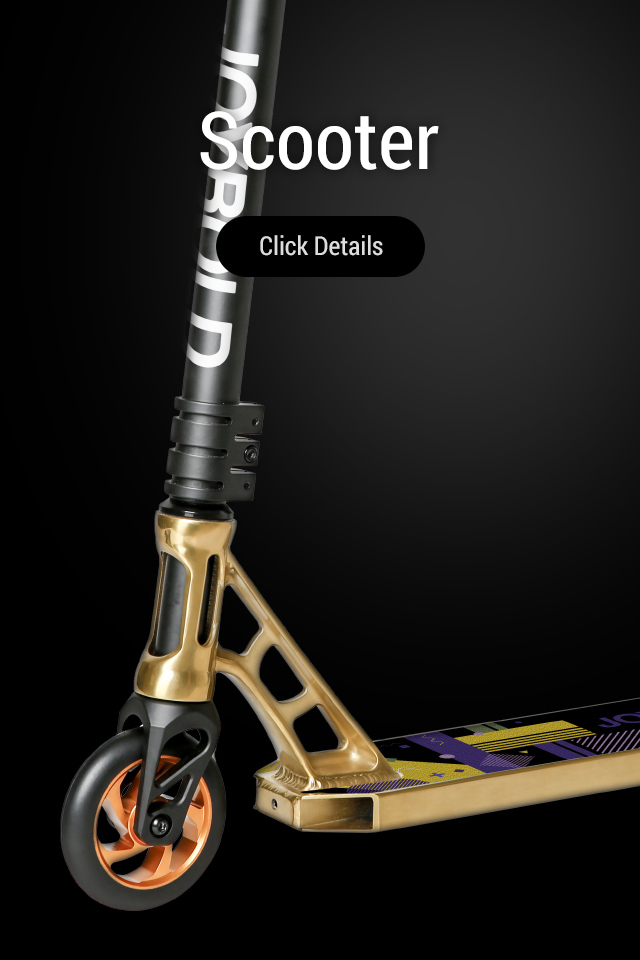
A stunt scooter is not a kick scooter with louder graphics, and a range plan for the category can be written around criteria that follow from the use stated in the brief: deck strength, steering and headset integrity, wheel cores specified for impact duty, and finishes specified to tolerate abrasion. Those are buying criteria — requirements to state in the brief and settle on samples — not a construction record for any individual reference: whether a given catalogue model is fixed or folding in format, how its deck is constructed, and which wheel specification it carries are facts of that model, confirmed in writing at quotation. Zhejiang Jinbang Sports Equipment Co., Ltd. presents this category inside its PRO scooter line, and its own catalogue description frames these models as scooters designed for extreme sports — also known in the market as off-road or mountain scooters in their rough-terrain variants. This page is written for wholesale and OEM buyers ranging stunt scooters for skate shops, sporting-goods chains and e-commerce.
The factory's workshop structure is on record: its own descriptions list metal welding and coating workshops, and the company operates a PU wheel line that spans diameters from 20 mm to 250 mm. That line is a company-level capability; it does not by itself settle where the wheels on a given stunt model come from. Which of those workshops produce a given stunt model's frames and steering parts, and whether that model's wheels are supplied from that line, are not things this page asserts from the general workshop list; production routes and wheel supply are confirmed model by model in writing at quotation, alongside deck construction, wheel specification and finish. A stunt programme therefore asks the buyer to fix the three specification items named above — deck construction, wheel specification and finish durability — as written specification items, instead of accepting a fixed imported bundle or an assumed process.
Specifying a stunt scooter range
A range plan in this category can be split in the brief by rider weight and park intensity. Put that split into the brief as requirements: the deck dimensions and overall weight each position must hold, the deck-neck and headset specification you are asking for, and the wheel core and hardness specification you want quoted — including the dehub-resistance requirement your market expects — rather than assuming any of them from the category name. Tell the factory who the rider is and which price position each model must hold, then sample ruthlessly: use the sample session to check the physical sample against each written requirement in your brief, item by item, before any production commitment.
Finish is a functional choice here, not decoration. State the abrasion expectations for frames in the brief: the factory's workshop list includes powder and liquid coating lines, and the coating route specified for a given frame is confirmed in writing at quotation rather than assumed from the list. Graphics should be specified on the same basis — placement and protection chosen with abrasion in mind, and the placement itself stated in the brief: for example in colour, deck underside prints or grip-tape designs, as the buyer chooses for the programme. Discuss these trade-offs at sample stage.
Wholesale, not retail
Everything here concerns the trade programme — specification, sampling and after-sales for volume orders; retail single-unit sales are not offered through this site. If you found it while researching the difference between trick and stunt terminology as a distributor, the trick scooter versus stunt scooter guide covers the vocabulary your retail customers will use. For the trade programme itself: MOQ, lead time and final specification are confirmed per quotation. Email your rider profile, target positions and branding requirements to [email protected].
Testing vocabulary for this category includes kick-scooter testing referencing EN 14619 and chemical screening referencing EN 71-3, both described by the company's laboratory. Confirm the documentation for the exact models in your order: Certificates available upon request. Buyers building a wider action-sports wall may also enquire about skateboards; whether lines can be combined in one programme is confirmed in writing at quotation.
After-sales parts belong in the first quotation
Wear items are part of the stunt programme conversation from the start: wheels, grip tape and finish items wear in use, so the spares package a wholesale buyer wants belongs in the first quotation rather than in a later discussion. Tell the factory which wear items your market will ask for, and ask which of them can be supplied for the exact models in your programme — including whether the wheels are supplied from the company's own PU wheel line — and have the answers confirmed in writing inside the same quotation. Agree the spares ratio at quotation, and your retail partners will have a documented route to the parts their riders request.
Send model references, your target market and branding requirements — MOQ and lead time are confirmed per quotation in writing.
Request a Quotation