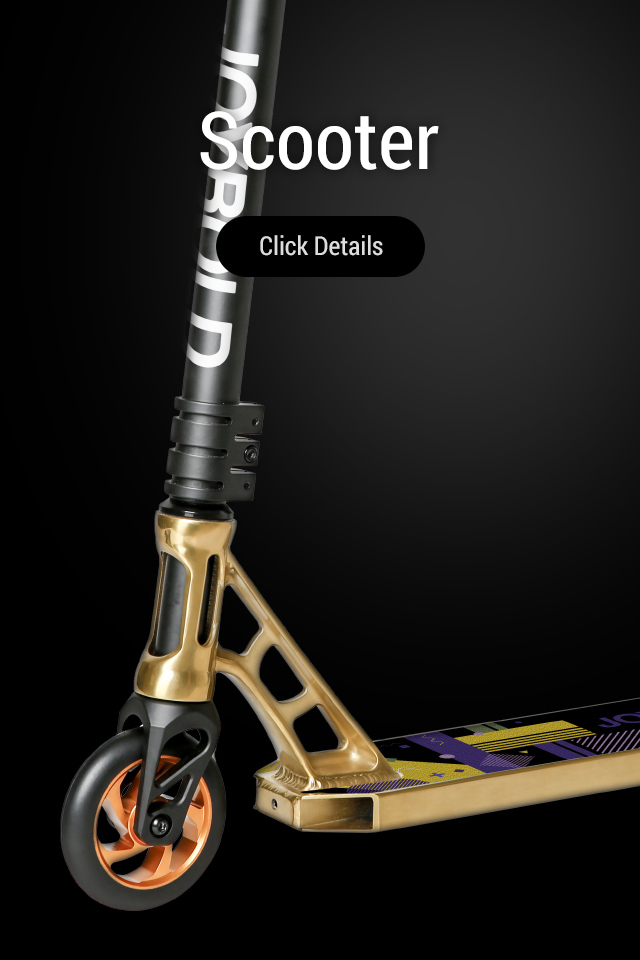
Ask the catalogue what its scooter line is, and it answers in its own words: "A scooter specifically designed for extreme sports, also known as an off-road scooter or mountain scooter." That sentence is the category brief for the scooter line of Zhejiang Jinbang Sports Equipment Co., Ltd. — a line of around 50 unique JB references, the company's core range, covering PRO, kick and tri-scooter formats. The line is positioned for off-road and mountain use at category level. What it does not do is assign that positioning to individual references, because the catalogue does not record an off-road attribute model by model. Which references answer an off-road brief is confirmed reference by reference in writing at enquiry.
Building an off-road brief
A buyer specifying for unpaved ground states the brief in directions and has each direction answered against a named reference. The surfaces the product will meet, described in the buyer's own terms — packed earth, gravel, rough pavement — belong in the brief as requirements, not as claims this page makes. Wheel diameter and construction belong in the brief the same way: the company operates its own PU wheel line covering diameters from 20 mm to 250 mm, and which wheel a given reference carries is a per-reference confirmation. Deck, fork and folding questions take the same route — asked per reference, answered in writing, and verified on samples of the exact reference before a programme is priced. The scooter wheels page sets out the wheel conversation in detail.
The brief should also name what the programme will not do. A reference confirmed against one set of surfaces has not been confirmed against every other use, and a confirmation read across uses is a confirmation nobody gave. Positions, uses and references stay in separate rows of the same file, each with its own written answer; the file is longer that way.
Samples before range decisions
An off-road position is a promise a retailer makes to a rider, and a catalogue brief cannot keep that promise on its own. The sample stage is where the brief stops being a description and becomes a specification: the exact reference, ridden on the surfaces the brief names, with the wheel and deck answers the enquiry produced in writing. If a reference does not answer the brief on a sample, the written exchange has still done its work — it has kept an unconfirmed position out of the range. Record the outcome either way in the programme file, reference by reference, so a reorder never quietly inherits a fit that was only ever assumed.
The off-road position inside the scooter line
The kick scooters page is the family overview for the whole scooter line, and the stunt scooters page covers the PRO format. The off-road positioning is the catalogue's own category positioning. The catalogue and its references are the same on all three pages, and each reference carries the same confirmation route. A programme that mixes trail-positioned and street-positioned references raises both in a single enquiry and has each reference's fit for its position confirmed separately.
Ordering information
Send your surface and use brief, the formats you are considering and your branding requirements to [email protected] to request a quotation. Which references suit the brief, their specifications, MOQ and lead time are confirmed per reference in writing. For documentation supporting your market: Certificates available upon request.
Send model references, your target market and branding requirements — MOQ and lead time are confirmed per quotation in writing.
Request a Quotation